It worked on my machine
Somewhere in your organisation there is a number the business now depends on. A forecast, a KPI, a customer segmentation. It lives in one analyst's notebook, on one laptop, and it ran once. Now the board wants it again, or the analyst has moved on, and it will not run the same way. This is the gap that reproducibility in data science is meant to close: the ability to run the same analysis, on the same data, and get the same result, on any machine, at any time.
The phrase you hear when this breaks is honest and expensive: it worked on my machine. The value did not leak because the work was bad. It leaked because the work was never captured. The code, the data, the library versions and the settings all lived in one head and one folder. When any of them changes, the result changes, and no one can tell why.
What reproducibility in data science actually means
The idea is plain. Give the same inputs to the same process and you get the same output, every time, regardless of who runs it or where. It is not a research luxury. It is what lets a second person trust a number they did not produce, and what lets you defend that number in a board room a year from now.
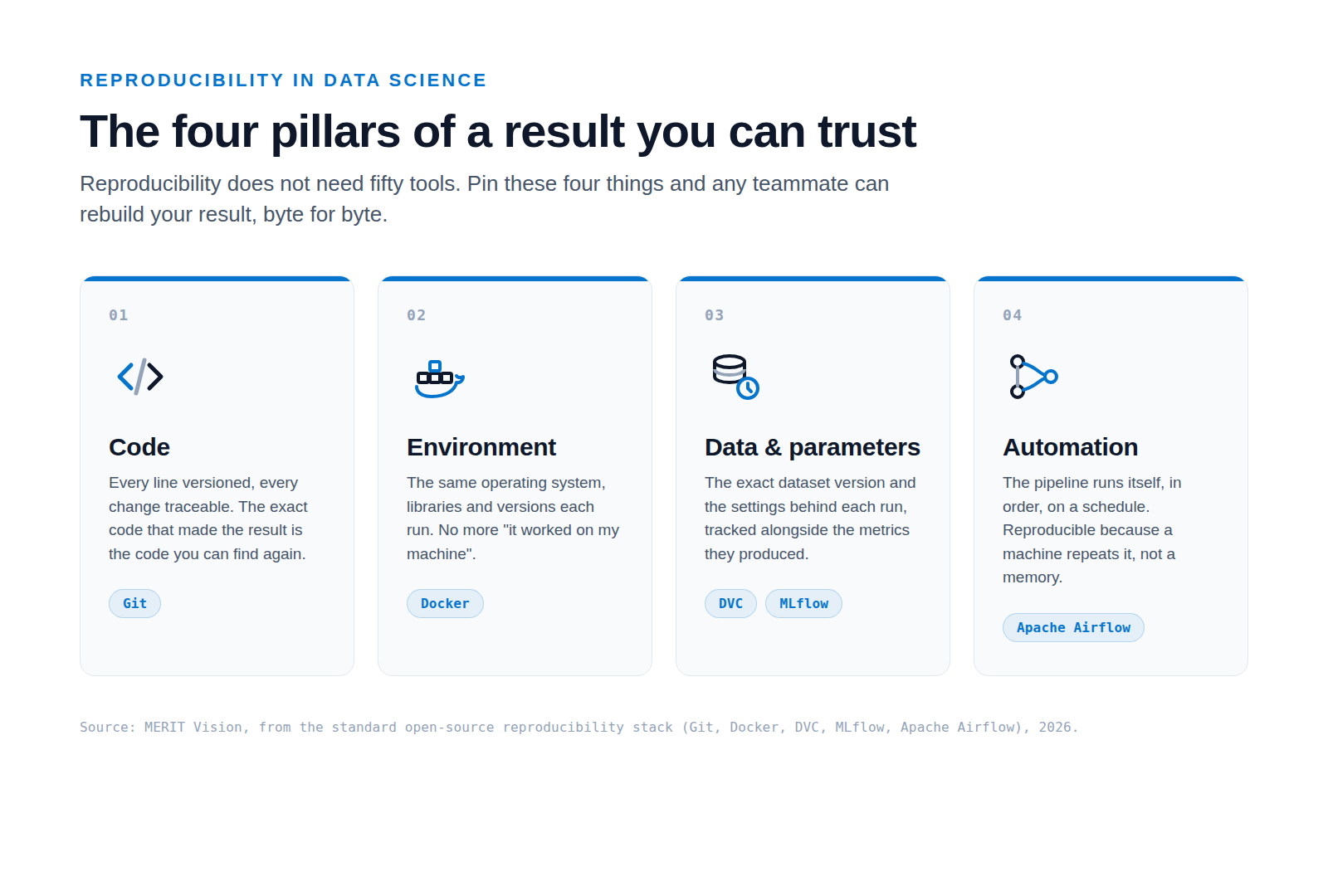
To reach it you have to pin four things. Not fifty. Four.
- Code: the exact version of every script and function that ran, not last week's copy.
- Data: the exact dataset used, including its version, not a table that keeps changing under you.
- Environment: the operating system, language and library versions, so a package update cannot quietly shift a result.
- Parameters: the settings, seeds and thresholds chosen for that run, written down, not remembered.
Pin all four and a result becomes repeatable. Miss one and you are trusting luck.
Even science struggles with this
If this feels hard, it is worth knowing that professional science wrestles with the same problem. In 2016 Nature surveyed 1,576 researchers about reproducibility, and the results were sobering. This is a structural problem, not a question of who to blame.
- More than 70%
- of researchers have failed to reproduce another scientist's experiments (Nature, 2016)